JavaScript Programming for Kids
An exciting beginner-friendly course that teaches kids how to code interactive web features using JavaScript.
This course introduces kids to the basics of programming using JavaScript in a fun and easy-to-understand way. Learners will discover how websites become interactive, the course encourages creativity, logical thinking, and problem-solving while building confidence in coding.
Requirements
- A laptop with a working webcam and microphone
- Stable internet connection (minimum 5 Mbps recommended)
- No prior programming experience required
Welcome to JavaScript Programming for Kids
Skill Relevance
In a world driven by software, coding is the new literacy. While HTML and CSS allow you to "speak" to the web, JavaScript allows you to "command" it. JavaScript is the most widely used programming language on earth — it runs in every browser, powers millions of applications, and is the foundation of technologies from Google Maps to online games to AI chatbots.
For kids, this skill is a genuine game-changer. It moves them from designing to engineering, sharpens computational thinking and mathematical logic, and provides the foundation for learning any other programming language — Python, C++, Java — later on. Most importantly, it empowers students to build tools, not just use them, giving them a meaningful edge in the future economy. The ability to make a computer do what you want it to do is one of the most transferable and valuable skills any young person can develop right now.
Key Benefits
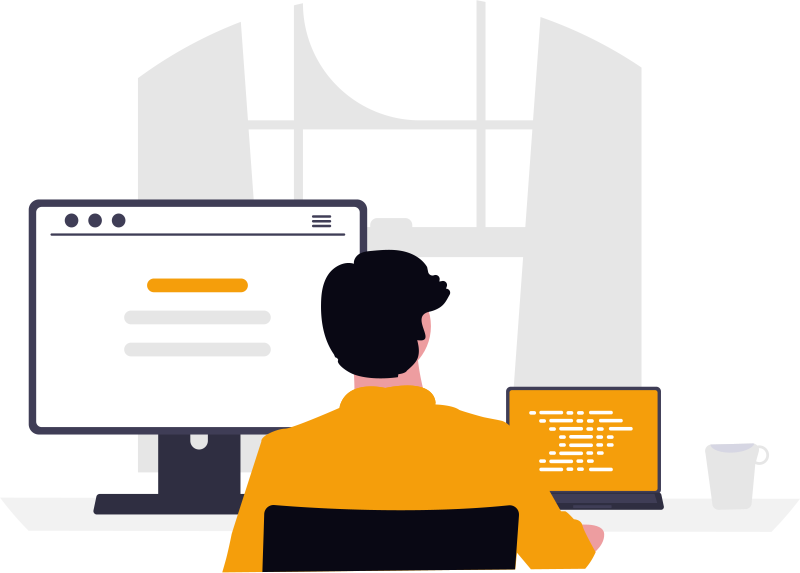
Students will learn to make websites interactive — turning static pages into living apps that react to clicks, typing, and movement. This is the fundamental shift from web design to web development: understanding that a website is not just a picture but a program. Every button press, every animation, every game mechanic on the web is powered by exactly what students will learn in this course.
This course builds the "Developer Mindset" — the ability to look at a broken program, form a hypothesis about what is wrong, test it, and fix it. Students practise debugging real code, reading error messages, and thinking systematically through problems. This logical, hypothesis-driven approach to problem-solving transfers directly to mathematics, science, and every analytical challenge a student faces in school and beyond.
By the end of the course, students will be writing modern, professional-standard JavaScript using arrow functions, objects, and event listeners — the same patterns used by developers at real tech companies. This is not a simplified toy version of the language. Students leave with the foundational knowledge to transition directly into full-stack development, game development, or any other advanced programming pathway.
Key Modules and Packages
The Basics of Logic — Variables & Data
JavaScript starts with how a computer remembers things. Students will learn to store information in variables (labeled boxes), perform calculations to track scores or health points, and collect user input to customise the experience. This module builds the mental model of data that underpins all programming.
Control Flow — The Brain of the App
This is where the magic happens. Students learn to give their programs a "brain" using If/Else statements to make decisions, loops to handle repetitive tasks instantly, and arrays to manage lists of items, players, or inventory. By the end, students can write programs that behave differently depending on what the user does.
Modern Interactivity — The DOM & Functions
Connecting code to the screen. Students learn to use Arrow Functions to write clean, professional scripts; group data into Objects to create complex characters or game entities; and use Event Listeners to make websites respond to mouse movements and clicks in real time. This is the module where programs truly come alive.
Mini Projects — Games & Interactive Apps
Students apply every concept to real, fun builds: a quiz app that tracks scores, a digital pet that reacts to clicking, and a clicker game with a leaderboard. Each mini project reinforces a specific set of skills and produces something tangible that students can show to friends and family immediately.
Capstone — Build Your Own Interactive Project
The course culminates in a personal capstone project each student designs and builds themselves. Whether it's a browser game, an interactive quiz, or a creative app, the capstone is entirely the student's own concept — their logic, their design, their code. It is the centrepiece of their growing developer portfolio.
Labour Market Opportunities
Frontend Developer
JavaScript is the primary language of the web browser. Every interactive element on every website — buttons, forms, animations, real-time updates — is built with JavaScript. Frontend development is one of the most in-demand and accessible entry points into the tech industry, with strong freelance and agency opportunities globally.
Software Engineer
The logical thinking and problem-solving habits built in this course are directly transferable to software engineering at any level. JavaScript knowledge specifically opens the door to full-stack development with Node.js, meaning a student who starts here can eventually build both the front and back end of complete web applications.
Game Developer
JavaScript is the language of browser-based games. Students who complete this course have a direct path into game development — applying event listeners, game loops, and object-oriented thinking to create interactive experiences. This pathway connects naturally to the Game Design for Kids course for students who want to go further.
Digital Entrepreneur
A young person who can write JavaScript can build and launch functional web products without depending on anyone else. From interactive portfolio sites to simple web apps and tools, JavaScript skills give students the ability to turn ideas into working software — one of the most valuable capabilities in the modern economy.
Who Should Attend
Kids Who Have Done Website Design and Want to Go Further (Ages 11+)
This course is the natural next step after HTML and CSS. Students who completed Website Design for Kids will find JavaScript to be the exciting upgrade that makes everything they built actually do things. The jump from design to development is one of the most rewarding transitions in a young person's coding journey.
Children Who Love Games and Want to Understand How They Work
Every browser game — every quiz, every clicker, every puzzle — runs on JavaScript logic. Students who want to go beyond playing games and start understanding and building them will find this course gives them precisely the tools they need. The mini projects are genuinely fun, functional, and something to be proud of.
Students Who Want to Think Like Engineers
JavaScript teaches the kind of systematic, logical thinking that defines engineering at every level. If-else decisions, loops, data structures, debugging — these are the mental tools engineers use daily, and this course introduces them through a language and context that is immediately engaging and rewarding for young learners.
Parents Who Want Their Child on the Developer Track
HTML and CSS teach kids how the web looks. JavaScript teaches them how it works. Together, these three technologies form the complete foundation of modern web development — and a student who has all three is genuinely prepared for advanced courses, university CS programmes, and the tech industry as a whole.
Frequently Asked Questions
Ready to get started?
Choose a class format that works for your schedule and budget.